Bypassing Parentheses Filters: Template Literals to the Rescue
After exploring JSFuck and character-based filtering, you might think that filtering parentheses would prevent function calls. However, JavaScript provides alternative syntax for calling functions that doesn’t require parentheses. In this article, we’ll explore the “No Parentheses Challenge” and learn how template literals can bypass filters that remove parentheses.
The challenge we’ll be working with is easy02.php from xss.challenge.training.hacq.me. This challenge demonstrates that even when parentheses are filtered, JavaScript execution is still possible using template literal syntax.
The Challenge: No Parentheses
Challenge URL: easy02.php
Let’s examine what this challenge does:
<script src="hook.js"></script>
<?php
// you cannot do anything without ...

// no parentheses ...
$escaped = preg_replace("/[()]/", "", $_GET['payload']);

// no event handlers!
$escaped = preg_replace("/.*o.*n.*/i", "", $escaped);
?>

<h1>Hello, <?= $escaped ?>!</h1>
Understanding the Filters
The code applies two filters to the user input:
Filter 1: Remove Parentheses
$escaped = preg_replace("/[()]/", "", $_GET['payload']);This regular expression /[()]/ matches:
- Opening parentheses
( - Closing parentheses
)
Any parentheses in the input are removed, which would prevent traditional function calls like alert('XSS').
Filter 2: Remove Event Handlers
$escaped = preg_replace("/.*o.*n.*/i", "", $escaped);This regular expression /.*o.*n.*/i matches:
- Any sequence containing the letters “o” followed by “n” (case-insensitive)
- This filters out event handlers like
onclick,onerror,onload,onfocus, etc.
The i flag makes it case-insensitive, so it catches variations like OnClick, ONERROR, etc.
The Problem
At first glance, these filters seem effective:
- No parentheses → Can’t call functions like
alert('XSS') - No event handlers → Can’t use
onerror,onload, etc.
However, JavaScript provides an alternative syntax for calling functions that doesn’t require parentheses: template literals.
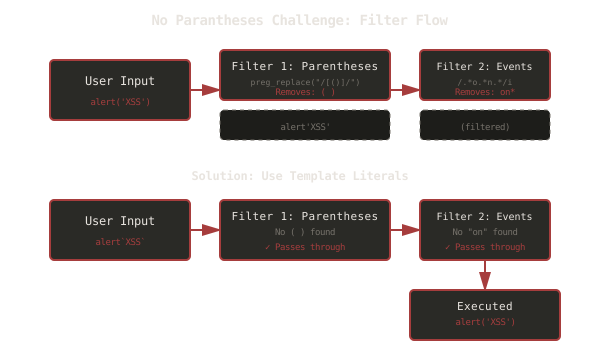
The diagram above shows how traditional function calls with parentheses are blocked, but template literal calls pass through both filters.
What are Template Literals?
Template literals (also called template strings) are a JavaScript feature introduced in ES6. They use backticks (`) instead of single or double quotes, and allow embedded expressions.
Basic Template Literal Syntax
// Traditional string
const name = "World";
const greeting = "Hello, " + name + "!";

// Template literal
const greeting = `Hello, ${name}!`;
Template Literals as Function Arguments
Here’s the key feature that makes this bypass possible: You can call functions with template literals without using parentheses.
// Traditional function call
alert('XSS');

// Template literal call (equivalent)
alert`XSS`;
When you use a template literal directly after a function name (without parentheses), JavaScript treats it as a function call with the template literal as the first argument.
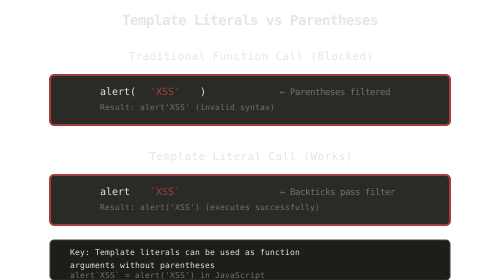
The diagram above illustrates the difference between traditional function calls (blocked) and template literal calls (allowed).
How It Works
When you write alertXSS“, JavaScript internally converts it to:
alert(['XSS'])The template literal becomes an array containing the string parts. For a simple template literal like `XSS`, this is equivalent to ['XSS'], which is then passed as the first argument to alert().
The Solution
To solve the challenge, we use a template literal instead of parentheses:
<script>alert`XSS`</script>Why This Works
-
No parentheses: The template literal syntax doesn’t use
()characters, so it passes Filter 1. -
No event handlers: We’re using a
<script>tag with a direct function call, not an event handler, so it passes Filter 2. -
Valid JavaScript:
alertXSS“ is valid JavaScript syntax that executes the alert function.
Complete Payload
The full payload for the challenge is:
<script>alert`XSS`</script>
When this is submitted:
- Filter 1 removes any
()characters (none found) ✓ - Filter 2 removes any
on*patterns (none found) ✓ - The payload passes through unchanged
- The browser executes
<script>alertXSS</script> - The alert is triggered!
Template Literals vs Traditional Function Calls
| Aspect | Traditional Call | Template Literal Call |
|---|---|---|
| Syntax | alert('XSS') | alertXSS“ |
| Parentheses | Required | Not required |
Filtered by /[()]/ | Yes | No |
| Functionality | Identical | Identical |
| Browser Support | All browsers | ES6+ (all modern browsers) |
| Use Case | Standard function calls | Bypassing parentheses filters |
When Template Literals Are Useful
Template literals are particularly useful for bypassing filters in these scenarios:
- Parentheses filters: When
()characters are removed - Strict syntax filters: When traditional function call syntax is blocked
- Multi-line payloads: Template literals support multi-line strings
- Expression embedding: Can embed expressions with
${}(though this requires more characters)
Advanced Template Literal Techniques
Multiple Arguments
While template literals primarily work with a single argument, you can still pass multiple arguments using other methods:
// Traditional
alert('Hello', 'World');

// Template literal (single argument)
alert`Hello World`;

// Multiple arguments with template literal (requires workaround)
[].constructor.alert`Hello``World`;
Tagged Template Literals
Template literals can also be used with “tagged” functions, which provides even more flexibility:
// Tagged template literal
String.raw`XSS`;

// This can be used to bypass certain filters
However, for the basic challenge, the simple alertXSS“ syntax is sufficient.
Security Lessons
This challenge teaches several important security lessons:
1. Syntax Filtering is Not Enough
Simply removing specific characters (like parentheses) doesn’t prevent JavaScript execution. Modern JavaScript provides multiple ways to achieve the same result.
Better Approach: Use proper output encoding based on context (HTML encoding, JavaScript encoding, etc.)
2. Multiple Filter Layers Can Still Fail
Even with two filters (parentheses and event handlers), the attack succeeds because:
- The filters target specific attack vectors
- They don’t account for alternative syntax
- They focus on blocking rather than allowing safe content
Better Approach: Use allowlists (whitelists) instead of blocklists (blacklists)
3. Context-Aware Protection
The same filtering approach won’t work in all contexts. A filter that removes parentheses might seem effective, but it doesn’t account for:
- Template literals
- Other ES6+ features
- Alternative function call syntax
- Future JavaScript features
Better Approach: Use context-aware output encoding and Content Security Policy (CSP)
4. Defense in Depth
Relying on multiple filters that target specific characters is fragile. A more robust approach includes:
- Input validation
- Output encoding (context-aware)
- Content Security Policy (CSP)
- Proper use of secure APIs (
textContentinstead ofinnerHTML) - Regular security updates and testing
Filter Bypass Strategies Comparison
| Strategy | Characters Used | Use Case | Filter Bypassed | Detection Difficulty |
|---|---|---|---|---|
| Template Literals | Backticks (`) | Parentheses filter | /[()]/ | Low |
| JSFuck | []()!+ | Alphanumeric filter | /[a-zA-Z0-9]/ | Medium |
| Event Handlers | onerror, onload | Script tag filter | <script> blocking | Low |
| Unicode encoding | Various Unicode | Character restrictions | Character filters | Low |
| HTML entities | &#xNN; | HTML context | HTML encoding | Low |
Key Takeaways
-
Parentheses filtering is insufficient: JavaScript provides alternative syntax for function calls.
-
Template literals bypass parentheses filters: Using backticks instead of parentheses allows function calls without
(). -
Multiple filters can still fail: Even with multiple layers, if they target specific syntax rather than the underlying behavior, they can be bypassed.
-
Syntax evolves: Modern JavaScript (ES6+) introduces new features that can bypass older filtering techniques.
-
Defense requires multiple layers: Don’t rely on character-based filtering alone.
-
Context matters: Different contexts require different protection strategies.
-
Allowlists over blocklists: Instead of blocking specific characters, allow only safe content.
Next Steps
Now that you understand how template literals can bypass parentheses filters, you can:
- Try the challenge yourself: easy02.php
- Experiment with other template literal variations
- Learn about other ES6+ features that might bypass filters
- Study Content Security Policy (CSP) as a more effective defense
- Practice with other filter bypass techniques
Remember: The goal isn’t just to bypass filters - it’s to understand why syntax-based filtering fails and how to implement proper security controls. Every bypass technique you learn helps you build more secure applications.
Related Articles
Bypassing Quotes Filters: String.fromCharCode() to the Rescue
December 20, 2025
Learn how String.fromCharCode() can bypass filters that remove quotes, and why filtering specific characters isn't enough for XSS protection
Bypassing Filters with JSFuck: When Character Restrictions Aren't Enough
December 18, 2025
Learn how JSFuck can bypass filters that remove alphanumeric characters, and why simple character filtering is insufficient for XSS protection
Learning XSS Through Practice: Baby Challenge Walkthrough
December 16, 2025
A beginner-friendly walkthrough of three XSS challenges that teach you exactly what Cross-Site Scripting is and how it works through hands-on practice